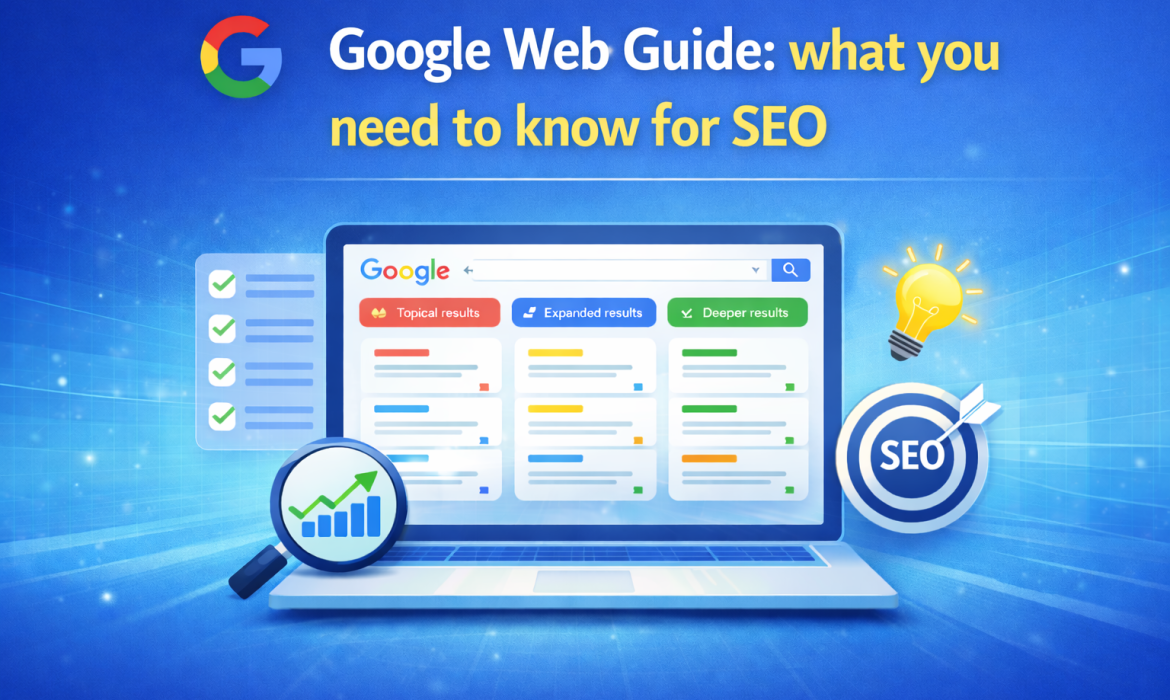
How Google Web Guide Works, and What It Means for SEO
Google is changing the way search results are presented again. After AI Overviews and AI Mode, there is now Google Web Guide, an AI-driven search experience that groups results by topic, angle, and intent instead of relying only on a flat ranked list.
In simple terms, Google Web Guide does not treat search as just a list of ten links. It tries to understand what the user is really exploring, which related subtopics matter, and which pages deserve visibility for each angle of that intent.
For SEO, that matters because it is no longer enough to have one indexed page with the exact keyword in the title. You need content that is easy to understand, easy to extract, easy to cluster, and strong enough to answer several related questions around the same topic.
If you want to see why classic SEO is moving closer to AEO, GEO, and SEO for ChatGPT, Web Guide is one of the clearest examples.
Table of Contents
ToggleHow to optimize content for Google Web Guide
There is currently no separate public rulebook created only for Web Guide. But there is a very clear direction: strong SEO fundamentals plus very clear intent-driven content. Google Search Central also says that the best SEO practices remain relevant for AI features in Google Search and that there are no extra requirements or special optimizations needed just to appear in AI features.
1. Write answer-first
At the beginning of each H2 or H3 section, answer the question directly in the first one or two sentences. Then expand. This helps both readers and extraction systems.
2. Cover real sub-questions
If Google expands a query through fan-out, your page should be built with the same mindset. Do not only write about the main topic. Also cover the questions people naturally ask around it.
For example, on a page about SEO for ChatGPT, related sub-questions might include:
- what SEO for ChatGPT actually means,
- how AI mentions a brand,
- the difference between a mention and a citation,
- why author pages matter,
- how to measure visibility in AI Search.
3. Use extractable structure
Lists, tables, checklists, short definitions, comparisons, and numbered steps are easier to interpret and repurpose. Not because content should sound robotic, but because clear pages are easier for modern search systems to work with.
4. Build logical internal linking
Internal linking becomes even more important when search systems are mapping relationships between topics. If you have one main page and several supporting pages that explain related angles, Google can understand the structure more easily.
For a brand that wants visibility in AI-driven search, blog articles should support service pages such as:
5. Make the entity clearer
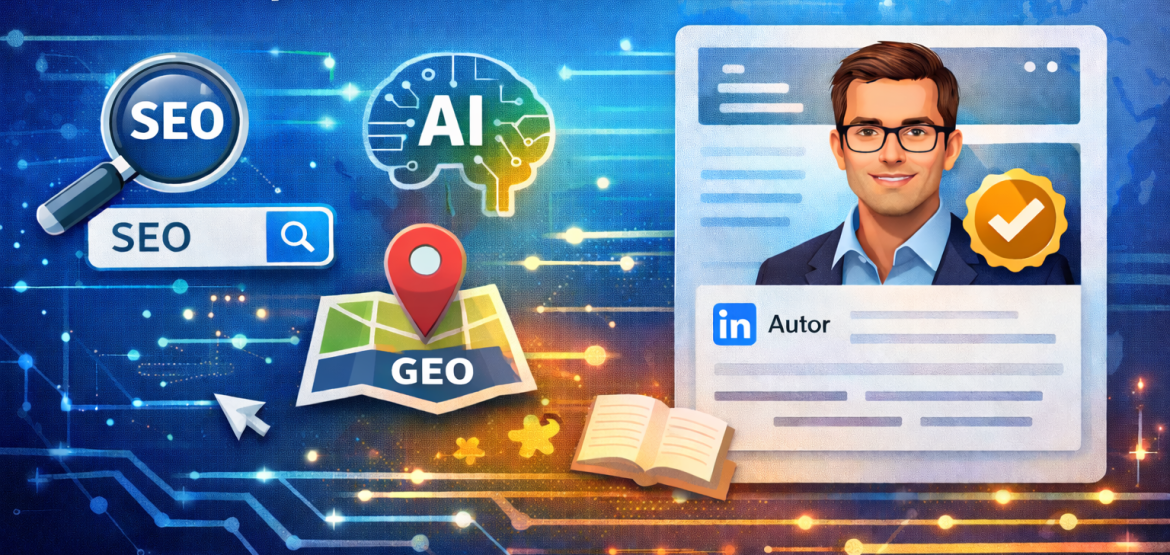
Web Guide, like AI Search more broadly, favors sources that are easy to understand. That means clear About, Team, author, and contact pages, a consistent brand description, and visible signs of real expertise.
6. Keep content accessible and readable
Google still recommends the basics: crawlability, indexability, accessible text content, good page experience, appropriate structured data where relevant, and helpful people-first content. Google has also said that AI-generated content itself is not against its guidance if it is created to help users rather than manipulate rankings at scale.
What to avoid
If Web Guide is based on understanding, grouping, and fast selection, weak content has even less room to compete. Avoid:
- artificially inflated pages with no clear answer,
- long introductions that say nothing specific,
- articles written only around a keyword target,
- repetitive content spread across multiple pages,
- service pages that stay too vague,
- missing authors or trust signals,
- generic FAQs that do not match real user intent.
A better way to think about content in 2026
Web Guide shows something important: the future of search is not only about winning clicks from a flat ranking page. It is about being selected across multiple contexts. That requires a shift in strategy.
It is not enough to be indexed. You need to be easy to understand, easy to extract, and easy to connect to user intent.
For many brands, that means moving from the mindset of “publish one article for one keyword” to a more mature model:
- one clearly defined main topic,
- supporting pages that cover secondary angles,
- short and direct answers,
- real examples and comparisons,
- consistent internal linking,
- measurement across AI environments, not just the classic SERP.
Frequently asked questions about Google Web Guide
What is Google Web Guide?
Google Web Guide is a Search Labs experiment that groups results into themed sections using AI, helping users explore different angles of a topic more easily.
How does query fan-out work?
Query fan-out expands an original search into multiple related searches, then combines and groups the most relevant results. This allows Google to show several perspectives for the same question.
Is Web Guide good for websites?
It can be. Because Web Guide organizes search by topic angles, it may create new visibility opportunities for highly useful pages that solve one specific aspect of user intent well.
Do I need a separate SEO strategy for Web Guide?
Not a completely separate one. The emphasis simply moves even further toward helpful content, clear structure, real expertise, topical coverage, and logical internal linking.
How is Web Guide related to SEO for ChatGPT?
Both reward content that is easy to understand, easy to extract, and strong across multiple intent angles. Web Guide reinforces the same direction we already see across AI-assisted search and answer engines.
External sources
- Google – Web Guide: An experimental AI-organized search results page
- Google – Supporting the web with new features and partnerships
- Google Search Central – AI Features and Your Website
- Google Search Central – Google Search’s guidance about AI-generated content
- Ahrefs – Google Web Guide: What It Is, How It Works, and What It Means for SEO
Is AI Content Bad for SEO?
For years, marketers have been asking the same question: is AI content bad for SEO?
The short answer is no.
AI content is not automatically bad for rankings, and it is not something Google bans just because a machine helped create it. What matters is the same thing that has always mattered in search: does the content help the user, answer the query, and add real value?
That distinction matters because many brands still frame this as an “AI vs human” debate. In reality, Google’s focus is much simpler. It does not reward content because a human wrote every word, and it does not reject content because AI helped draft it. It rewards pages that are useful, trustworthy, and worth showing in search.
Table of Contents
ToggleWhat Google actually says about AI content
Google’s guidance is clearer than many people realize. The company has stated that it focuses on the quality of the content, not the method used to produce it. At the same time, it warns that using automation or generative AI to publish large numbers of pages without adding value can violate spam policies.
In practice, that means two things can both be true at the same time:
- AI-assisted content can be completely acceptable for SEO.
- AI-generated content can become a serious risk when it is used to create scaled, low-value pages designed mainly to manipulate rankings.
That is the real line. Google is not against AI. Google is against spam.
Why AI content can perform well in SEO
Search engines do not rank pages based on the writing tool. They rank pages based on how well those pages satisfy intent and whether users can trust them.
That means AI-assisted content can perform well when it does the things strong SEO content should already do:
- answer the search intent clearly
- cover the topic completely
- include accurate, verified information
- add unique insights, examples, or data
- demonstrate real expertise and review
- offer a better experience than competing pages
In other words, AI is a workflow advantage, not a ranking signal. If it helps you create a better page, faster, that can be a competitive edge. If it helps you flood your site with weak pages, that becomes a liability.
The real problem is scaled low-value content
Where many businesses go wrong is not that they use AI. It is that they use AI as a shortcut to mass-produce pages with almost no editorial judgment.
This is exactly where SEO risk appears.
If a brand publishes dozens or hundreds of near-identical articles, doorway pages, city pages, or affiliate pages with little added value, that is not a smart AI content strategy. That is a scaled content problem.
Common warning signs include:
- pages that say the same thing with slight keyword variations
- content that sounds polished but says very little
- facts, dates, or examples that have not been verified
- no original expertise, experience, or perspective
- content created mainly to fill keyword gaps rather than help users
Google does not need to know whether that content was drafted by ChatGPT, written by a junior freelancer, or assembled by a content farm. If it is weak and unhelpful, it is weak and unhelpful.
Human-written content is not automatically better
This is the part many people still overlook.
Human-written content can be just as generic, shallow, manipulative, or outdated as AI-written content. Search engines have had to deal with low-quality human content for years.
That is why the idea that “human content is safe, AI content is dangerous” misses the point. A page should not rank because it was written manually. It should rank because it is the best result for the query.
The real question is not:
Was AI involved?
The real question is:
Does this page deserve to rank?
What good AI-assisted SEO content looks like
The strongest use of AI in SEO is not one-click article generation. It is using AI to improve the content workflow while keeping quality control in human hands.
A practical AI-assisted workflow usually looks like this:
1. Use AI for research and structure
AI can help you organize ideas, build outlines, identify subtopics, and speed up the briefing process.
2. Add human expertise
This is where content becomes difficult to copy. Add experience, brand knowledge, case-study insights, opinions, screenshots, examples, and stronger explanations.
3. Fact-check everything
AI can write confidently and still be wrong. Verify claims, statistics, terminology, and dates before publishing.
4. Improve originality
Do not publish a generic summary of what everyone else has already said. Add a clear point of view and useful differentiation.
5. Edit for clarity and extractability
Strong content today should not only rank in traditional search. It should also be easy for AI systems to understand, quote, summarize, and cite.
6. Scale only after quality is proven
If your process cannot maintain consistent quality, do not scale it. Scale quality, not just output.
Why this matters even more in AI search
Search is no longer only about blue links. Brands also want visibility in AI Overviews, AI assistants, answer engines, and conversational search platforms.
That changes the content standard even further. Pages now need to be not only rank-worthy, but also easy to parse, trustworthy to cite, and structured well enough to be extracted into AI-generated answers.
That is one reason we talk about Generative Engine Optimization (GEO) and Answer Engine Optimization (AEO) alongside traditional SEO. The future of visibility is not just ranking pages. It is becoming a source AI systems can understand and reference.
If your brand is investing in SEO for ChatGPT or broader AI search visibility, content quality becomes even more important. Generic content may still get indexed, but it is far less likely to become the kind of source that earns mentions, citations, and trust.
So, is AI content bad for SEO?
No.
AI content is not bad for SEO by default, and it is not something Google automatically penalizes. What Google targets is low-value content created mainly to manipulate rankings. That applies whether the content was created by AI, humans, or a mix of both.
The better rule is simple:
Helpful content wins. Spam loses.
If AI helps you create content that is more accurate, more useful, better structured, and more competitive, it can absolutely support SEO performance. But if AI is used to mass-produce pages with no real value, it will create the same problem low-quality content has always created.
The future does not belong to AI-only content or human-only content. It belongs to high-quality content supported by smart workflows.
Need help with SEO, GEO, or AI Search visibility?
GEO Agency helps brands create content that is built for modern search — from Google rankings to AI-generated answers.
Contact GEO Agency to discuss your content and AI visibility strategy.
FAQ
Is AI content bad for SEO?
No. AI content is not bad for SEO by default. What matters is whether the page is useful, accurate, original, and created for people rather than to manipulate rankings.
Does Google penalize AI-generated content?
Not simply because AI was used. Google’s concern is spammy, low-value, or scaled content abuse, not the presence of AI in the workflow.
Can AI-written articles rank on Google?
Yes. AI-assisted articles can rank well when they satisfy search intent, add real value, and are reviewed carefully for accuracy and trust.
What is the safest way to use AI for SEO content?
Use AI for research, ideation, and structure, then add expert input, fact-checking, original insights, and strong editorial review before publishing.
External sources
Marketing AI Examples That Really Work in 2026
AI marketing is most effective when it accelerates research, production, analysis, and iteration without replacing strategy, creativity, or quality control. Practical examples analyzed by Ahrefs show that AI delivers real results when used to support marketers, not replace them.
For companies in Romania, the takeaway is clear: it’s not about using numerous tools at random, but about having a few well-defined processes where AI optimizes efficiency. For visibility in both Google and AI-generated responses, we recommend integrating these processes with SEO for ChatGPT, AEO, and GEO.
Table of Contents
ToggleWhy AI Marketing Matters in 2026
AI marketing is valuable because it reduces time spent on repetitive tasks such as summarizing, structuring, generating ideas, message variants, review analysis, grouping themes, and turning raw notes into clear deliverables. This allows teams to test more in less time.
However, speed alone is not enough. Using AI without a clear process leads to generic content and campaigns similar to others. A well-structured workflow provides a real operational advantage.
In short, AI marketing does not mean automatic results. It means using AI to accelerate essential activities: research, positioning, clarity, and execution.
8 AI Marketing Examples That Actually Work
Analyzing reviews to uncover what matters to customers
One of the most useful examples is analyzing customer or competitor reviews. AI can quickly spot patterns: what customers appreciate, what frustrates them, recurring phrases, and which benefits influence purchasing decisions.
This information can then improve messaging in ads, product pages, landing pages, or emails. For local businesses or online stores, this is an easy-to-implement tactic.
Generating visual concepts before the final product exists
AI is useful for creating mockups, visual directions, or concept images in the pre-launch phase of a campaign. You can quickly test creative angles, scenes, and messaging before investing in full production.
This approach is valuable for teams with tight deadlines. It’s essential that AI-generated images reflect the real product, as discrepancies can affect conversion and customer trust.
Combining real photography with AI-generated backgrounds
A practical application is using AI to create backgrounds, scenes, or settings while photographing the real product professionally. This reduces production costs without compromising the presentation of the main product.
This method works well for products, accessories, cosmetics, packaging, or other items that need a premium look without complex interactions with the environment.
Accelerated research for articles and reports
AI can significantly cut research time. It can summarize interviews, survey responses, internal notes, technical documents, or long articles, helping teams quickly identify key ideas.
This process doesn’t eliminate the need for verification but greatly reduces time spent reading and reorganizing information. For educational or commercial content, this is one of the most valuable uses.
Turning raw notes into newsletters or clearer materials
Many teams use AI to transform bullet points, disorganized ideas, or voice notes into a coherent draft. A specialist then edits, adjusts, and adds practical experience.
This method works well for newsletters, short articles, weekly updates, educational emails, and client summaries.
Faster brainstorming for videos, campaigns, and posts
AI can quickly generate multiple angles, titles, hooks, thumbnail ideas, and content structures. Not all will fit, but it provides an efficient starting point.
For content and social media teams, AI facilitates idea exploration. Final decisions remain with the team, but idea generation becomes faster and more efficient.
Automating repetitive production tasks
AI can automate tasks like rewriting meta descriptions, generating alt text for images, formatting text, structuring drafts, or breaking long content into shorter versions.
The benefit is not only time-saving but also increased consistency. For high-volume workloads, AI helps maintain a high standard of delivery.
Optimizing content for classic and AI search
A relevant SEO AI example is using AI to identify missing topics, real frequently asked questions, and generate clearer answers. Instead of writing just for keywords, you can structure content to be easily extracted and cited.
For a deeper dive, see our guides on SEO for ChatGPT, the difference between SEO and AEO, and how to write answer-first paragraphs.
Lessons You Can Apply to Your Website
The most important lesson is that AI delivers the best results in a well-structured process. It cannot replace strategy, differentiation, or audience understanding.
- Use AI for research and organization, not just text generation.
- Test multiple message, title, and creative angle variants.
- Keep human control over examples, data, tone, and conclusions.
- Turn customer feedback into better content.
- Build content that clearly answers real questions.
If you already have a blog, start by optimizing existing articles: rewrite introductions, clarify subtitles, add direct answers, FAQ sections, and internal links to service pages. For inspiration, see our article on SEO for ChatGPT.
Connecting AI Marketing to SEO, AEO, and GEO
AI marketing and AI Search are different but complementary concepts. AI marketing streamlines content creation, while SEO, AEO, and GEO structure it for easy understanding, extraction, and recommendation.
For example, a good AI Search article should include:
- Clear answers in the first sentences of each section
- Titles that reflect real questions
- Easily extractable lists and steps
- Clear authorship and trustworthy pages
- Interlinking to important site pages
For a Romania-focused strategy, see our guide on SEO for ChatGPT Romania, our practical GEO page, and our article on LLM citations, traffic, and brand authority.
Frequently Asked Questions
What does AI marketing mean?
AI marketing means using artificial intelligence for research, analysis, content ideas, assisted production, testing, and optimization. AI doesn’t replace strategy; it accelerates execution and helps teams make better decisions.
Can AI completely replace a marketer?
No. AI can automate repetitive tasks and generate quick variants, but strategy, positioning, information validation, creativity, and final decisions remain human responsibilities.
What are the best uses of AI in marketing?
The best uses include accelerated research, data summarization, generating creative variants, structuring content, analyzing customer feedback, campaign ideas, and workflow optimization.
How do you connect AI marketing with SEO, AEO, and GEO?
AI marketing helps teams create clearer, better-structured, and more extractable content for AI engines. Combining AI marketing with SEO for ChatGPT, AEO, and GEO is more effective than using AI for quick text alone.
Is publishing AI-generated text enough?
No. Texts without human editing risk being generic, incomplete, or inaccurate. Good content uses AI for speed but maintains human control for experience, examples, validation, and differentiation.
External Sources
Why the Author Page Matters for SEO, AEO, and GEO
The author page plays a crucial role for SEO, AEO, and GEO because it shows who creates the content, their experience, and why the information presented can be considered trustworthy. For a site aiming to be properly recognized by Google and easily cited in AI Search, the author page is not just a design element—it becomes an important indicator of clarity and credibility, helping to strengthen the editorial profile.
On a site dedicated to SEO for ChatGPT, AEO, and GEO, the importance of the author page increases because it’s not just visitors who need to know who writes, but also search engines and AI models analyzing sources to identify credible entities and content backed by experience. In this way, the author page supports both human understanding and automated recognition of content value.
Table of Contents
ToggleWhat Is an Author Page
An author page is a section that explains who publishes or signs the content. It should include the real name, role in the company, relevant experience, areas of expertise, verifiable public profiles, and a clear connection between the author and the brand. This information increases transparency and builds trust in the content.
In practice, the author page answers simple questions:
- Who wrote this content?
- Why are they qualified to write on the subject?
- What experience do they have in the field?
- Where can their professional identity be verified?
- What other materials have they published?
If your site publishes articles such as What is SEO for ChatGPT or What is GEO, the author page complements the article information and helps readers understand who is providing that perspective.
Why the Author Page Matters for SEO
From an SEO perspective, the author page contributes to building trust, provides additional context, and helps search engines interpret content correctly. While it doesn’t automatically guarantee higher rankings, it strengthens the site’s editorial profile and supports the overall credibility of the published information.
Provides Context About Expertise
Google explains in its documentation on helpful content that users and search engines should understand who created the content and why it can be trusted. An author page supports exactly this.
Source: Google Search Central – Helpful Content
Supports E-E-A-T Signals
If your site already has content on E-E-A-T, the author page is one of the most direct ways to demonstrate experience, expertise, and trust. A site that publishes many articles without clear authorship risks appearing generic and lacking identity. When it’s visible who publishes, reviews, and is responsible for content, the site becomes easier to understand, evaluate, and appreciate—both by users and search engines.
Improves User Experience
The author page isn’t just for SEO. It helps readers decide whether to trust the content. In emerging areas like SEO for ChatGPT in Romania, this is even more important.
Why the Author Page Matters for AEO and GEO
In AEO and GEO, the author page becomes an important signal of entity and editorial credibility, as AI systems attempt to summarize, recommend, or cite relevant sources. The clearer the site presents who the authors are and the connection between author, brand, and topic, the more likely the information is interpreted correctly and used as a reference source.
Entity Clarity
An AI model or search engine can better understand who the author is, in what context they write, and their connection to the brand. This is especially important when you want to be consistently associated with topics like SEO for ChatGPT, AEO, GEO, and AI Search Romania.
Semantic Consistency
If the author’s name, biography, LinkedIn profile, and published articles show the same specialization, a coherent semantic profile forms. This reinforces the themes covered by service pages, supporting articles, and external presence. Consistency helps recognize expertise and strengthens reputation.
Trust for Extractable Content
In answer-first articles, clear, easily extractable paragraphs are essential, but even more valuable when associated with a real author. In this way, the author page complements the article’s citable structure and increases the chances that the information is used as a trusted source.
What a Good Author Page Should Include
An effective author page should be clear, verifiable, and provide relevant information for the topics covered. It doesn’t need long or unnecessary text, but concrete details that inspire trust and demonstrate the author’s real experience.
Recommended Elements:
- Real name of the author
- Professional, real photograph
- Exact role in the company
- Short description of experience
- Areas of expertise
- Link to LinkedIn profile
- List of published articles
- Optionally, content reviewer/editor if applicable
For a brand like SEO AI, an effective approach is to show the author as a real person with a “Published by [Brand]” note. This maintains both the human component and company entity, which strengthens credibility and brand recognition.
What to Avoid:
- Authors without a real identity
- Vague biographies without specialization
- False or exaggerated titles
- Empty author pages without links or context
- Mismatches between author, public profiles, and topics
- Connecting the Author Page to the Rest of the Site
The author page should be integrated into the site structure rather than left isolated. A simple integration model includes:
- Author name appears under the article title
- Name links to the author page
- Author page lists published articles
- Key articles link internally to service and guide pages
For example, from an author page you can naturally link to:
- SEO for ChatGPT
- AEO Romania
- GEO in Romania
- Pricing page
- Contact page
Author Page and Structured Data
Structured data doesn’t replace a good author page but can add extra clarity. In addition to FAQ schema included on the page, consider structured data types for organization, person, article, and breadcrumbs. Official documentation is available at Schema.org Person and Schema.org Article.
For FAQ pages, the official type is Schema.org FAQPage, and Google’s guide for eligibility and implementation is in Search Central: FAQ structured data.
Frequently Asked Questions
What is an author page?
An author page is a dedicated page for the person signing content, showing who they are, their experience, and the topics they cover.
Why does the author page matter for SEO?
It matters because it provides context about expertise, builds trust, ensures editorial clarity, and helps users and search engines understand the content.
How does the author page help in AEO and GEO?
It improves entity clarity and credibility. AI systems can better understand who produces content and why the source deserves attention.
What should an author page include?
It should include the real name, photo, role, relevant experience, areas of expertise, LinkedIn profile, and published articles.
Is it enough to just put the author’s name under the article?
No. It’s better if the author’s name links to a full author page that provides context and evidence of credibility.
Can an author page increase chances of being cited in AI Search?
It doesn’t guarantee citations but improves clarity and trust, which indirectly supports mentions, recommendations, and citations.
External Sources
What is LLMs.txt, What It Does, and Is It Worth Adding to Your Site?
Table of Contents
ToggleWhat is LLMs.txt
LLMs.txt is a proposed standard designed to help AI models and some AI crawlers better understand a website for SEO in ChatGPT. The file is intended as a simple summary (in Markdown) of the most important pages on a site, each accompanied by a short description.
What Problem Does It Solve
According to Semrush, LLMs.txt addresses two main issues:
Modern websites can be difficult for some systems to “read” (complex HTML, content loaded via JavaScript).
Lack of prioritization—crawlers may spend time on irrelevant pages, and AI may generate responses from low-quality sources.
Recommended Structure
- Generally, LLMs.txt is suggested to be written in Markdown and include:
- A title (the company or site name)
- A short description (1–2 lines)
- Sections (e.g., Products/Services, Documentation, Company)
- Links to important pages + a brief description for each
Adoption and Effectiveness: Is It Worth It Now?
Semrush takes a cautious stance: at present, LLMs.txt is more of an experiment than a guaranteed-impact tactic. Web-scale adoption is still low, and major AI companies have not officially confirmed that they use LLMs.txt for crawling. Additionally, Semrush notes that no clear correlation was observed between having LLMs.txt and increased AI visibility in practical tests.
Steps to Implement LLMs.txt
Select the pages you want to prioritize (services/products, pricing, about, contact, up-to-date pages).
Create the LLMs.txt file in Markdown with links + short descriptions.
Upload it to the root (e.g., https://yourdomain.com/llms.txt) and keep it updated.
Practical Recommendation for SEO / AEO / GEO
If your goal is to be mentioned or cited by AI, LLMs.txt can be a “low-effort” experiment, but it should not be the top priority. More reliable signals remain:
- Clear pages
- Extractable content (answer-first, lists, FAQ)
- AEO practices
- Coherent internal linking
- Evidence of expertise/trust (E-E-A-T)
- Relevant external footprint (GEO)
FAQ
What is LLMs.txt?
LLMs.txt is a file (usually in Markdown) that lists the most important pages of a site with brief descriptions to make them easier for AI systems and crawlers to understand.
Where should LLMs.txt be placed on the site?
Typically in the root, so it’s accessible at: https://yourdomain.com/llms.txt.
Does LLMs.txt replace robots.txt or sitemap.xml?
No. robots.txt controls crawler access, sitemap.xml helps discover URLs, and LLMs.txt is a “clean” prioritized list of pages for AI.
Does LLMs.txt help you appear in ChatGPT?
It may help as an experiment for clarity, but it is not a shortcut. Real visibility comes from clear pages, citable content (AEO), and trust signals + mentions (GEO).
Which pages should I include in LLMs.txt?
Typically: services/products, about, contact, pricing, FAQ, and 1–3 essential guides/pages (up-to-date). Keep the list short (5–15 links).
How often should it be updated?
Whenever important pages change (structure, slugs, services, pricing, guides). If changes are frequent, check monthly.
Is LLMs.txt an official standard used by all AI?
No universal adoption has been confirmed. LLMs.txt is more of a proposal/experiment, so treat it as “nice-to-have,” not a top priority.
What is more important than LLMs.txt for AI Search?
- Clear pages (who you are, what you offer, for whom)
- AEO: answer-first, lists, FAQ + extractable structure
- GEO: trust signals + relevant external footprint
- Monitoring real prompts (mention vs citation vs recommendation)
External Links
AEO and GEO are SEO 2.0 – SEO adapted for AI Search
In the “SEO century,” many strategies started with short keywords (e.g., “sofa bed”). In AI Search, people write full intents, with constraints and criteria: “I want a quality sofa bed, delivered in 2 days, in Bucharest. What do you recommend?”
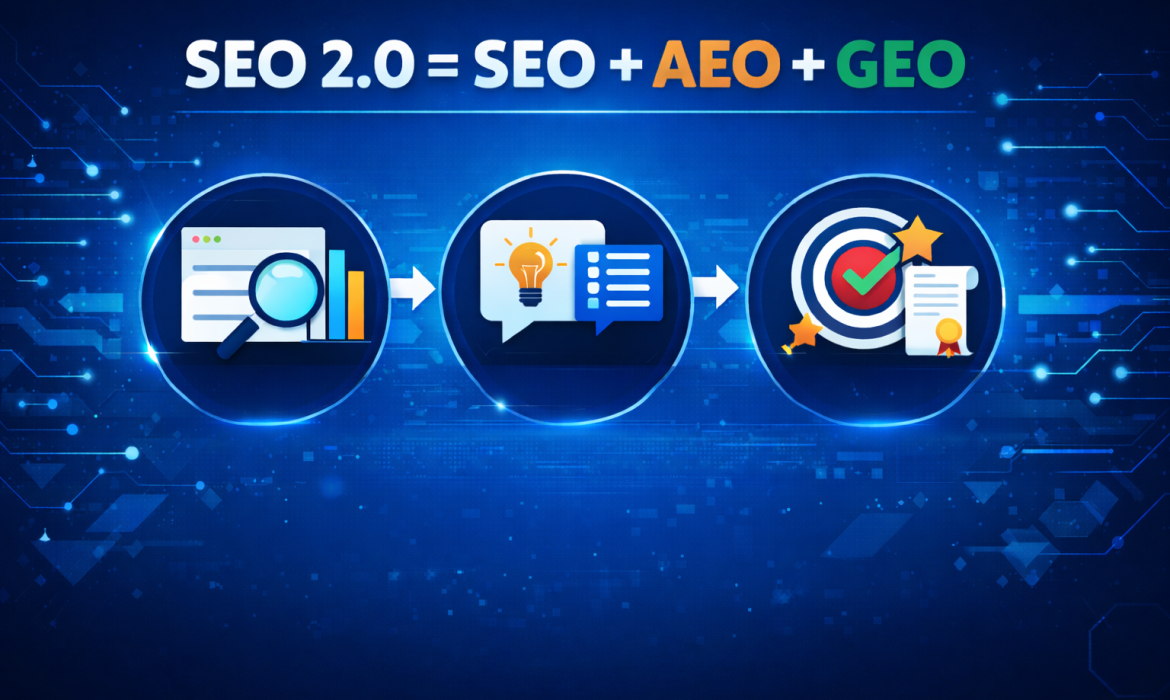
This is where SEO 2.0 comes in: SEO doesn’t disappear, it expands. The extension goes in two directions: AEO (to be the answer) and GEO (to be the recommendation).
Table of Contents
ToggleWhy “SEO 2.0” Doesn’t Mean “New SEO”
Classic SEO remains the foundation (indexing, structure, relevant content, authority). But AI Search compresses options: often users receive only 1–3 recommendations or a direct answer. This creates two new needs:
-
Extractable content
-
Clear trust signals
AEO = SEO 2.0 for Answers
AEO (Answer Engine Optimization) means structuring your content as answers to real questions, in a format easy for AI and Google to extract.
How AEO looks in practice:
- Answer-first: provide the answer in the first 1–2 sentences under each H2.
- Lists, numbered steps, tables, checklists (not just long paragraphs).
- FAQ with real questions (8–12 on important pages)
- Schema markup (FAQPage / Article) where it makes sense.
GEO = SEO 2.0 for Recommendations
GEO (Generative Engine Optimization) means building signals that increase the chance a generative AI model will recommend you: clear entity, evidence (E-E-A-T), consistency, and external footprint (mentions/citations).
How GEO looks in practice:
-
Clear entity: who you are, what you offer, for whom, location (Romania/cities).
-
Evidence: real author, team, results, testimonials, case studies.
-
External footprint: mentions in relevant sources (lists, articles, PDFs), no spam.
-
Consistency: same description everywhere (site, LinkedIn, directories).
The Difference in Short
- SEO = be found
- AEO = be the answer
- GEO = be the recommendation
Simple Example: Keyword vs Intent
-
Classic SEO: “sofa bed” → category page + on-page optimization + links.
-
SEO 2.0 (AEO + GEO): “I want a quality sofa bed, delivered in 2 days, in Bucharest” → page that clearly answers (answer-first), short list (2–3 options), FAQ (delivery/returns/warranty), evidence (reviews, materials) + external footprint (citable assets).
External Links (Useful Sources)
- Google Search Central: official documentation
- Schema.org FAQPage: FAQPage specification
- Ahrefs (LLM citations): guide on LLM citations
FAQ (for Page / Article)
Do AEO and GEO replace SEO?
No. AEO and GEO complement SEO. SEO remains the foundation, while AEO/GEO are extensions for answers and recommendations in AI Search.
How many prompts should I monitor?
A good set is 20–60 prompts, divided by intent (informational, commercial, comparative).
Does FAQPage schema help?
Yes, it helps maintain consistent Q&A structure, but the most important thing remains clear content and real questions.
How long until results appear?
Generally, initial signals appear in 30–90 days, depending on niche, authority, and external footprint.
What is more important: mention or citation?
Mentions increase awareness. Citations bring authority and clicks when available. The most valuable are the top 1–3 recommendations for commercial prompts.
How to Write “Answer-First” Paragraphs (with Examples)
Table of Contents
ToggleTable of Contents
- What “Answer-First” Means
- Why It Works for AI Search and Google
- Ideal Format (Template)
- Real Examples (Before / After)
- Quick 10-Point Checklist
FAQ + Schema
1) What “Answer-First” Means
Answer-first = the answer to the question is the first piece of information the reader (and AI) sees. Only after that do you explain why, how, examples, or exceptions.
Simple rule: if someone scans the page for 10 seconds, they should be able to say: “Yes, here’s the answer.”
Answer-first is the “backbone” of AEO (Answer Engine Optimization) and also helps GEO, because your answers become easier to use as a source.
2) Why It Works for AI Search and Google
AI models and search engines prefer content that is clear, extractable, structured, and verifiable. That’s why pages with definitions, how-to guides, FAQs, and comparisons tend to be more “citable.”
See also the guide on citations: LLM Citations
Useful external references:
- Schema.org FAQPage
- Google Search Central
3) Ideal Format (Template)
Use the structure below for almost any H2/H3:
H2: Question / Topic
1–2 sentences: direct answer (answer-first)
3–6 sentences: context + why it matters
List / Steps: how to apply
Example: one concrete example
Mini-CTA: what to do next (optional)
Short Answer Template:
Answer: [1 clear sentence]
Why: [1 sentence]
How: [3 bullet points]
Template for Commercial Pages:
- Answer: what you offer + for whom + location (Romania)
- Evidence: results / testimonial / expertise
- Next Step: CTA (pricing / audit)
4) Real Examples (Before / After)
Example 1: “What is AEO?”
Before (generic):
AEO is a modern concept that is becoming increasingly important in digital marketing. In recent years, many changes have appeared…
After (answer-first):
AEO (Answer Engine Optimization) means structuring your content as answers to real questions (FAQ, how-to, lists) so it’s easy for AI and Google to extract.
Practically, AEO helps you be the answer, not just a link.
Page: AEO Romania
Example 2: “How to appear in ChatGPT?”
Before:
To appear in ChatGPT, you need a good website and to be known. There are many methods, and it depends on multiple factors.
After (answer-first + steps):
To appear more frequently in AI responses, you should:
Have clear pages about who you are and what you offer
Structure your answers to be extractable (lists/FAQ)
Have credible mentions outside your website
Start with 20 real prompts (with constraints) and optimize pages that answer them directly.
Full guide: SEO for ChatGPT Romania
Example 3: “GEO Romania” (short definition)
GEO Romania means building trust signals + external footprint (mentions/citations) so AI recommends you in the top 1–3 options for local questions (Romania, cities, criteria).
It’s not just link building: include entities, evidence, consistency, and citable assets (PDFs/summaries).
See: GEO Romania
5) Quick 10-Point Checklist
- Answer in the first 1–2 sentences under each H2.
- Use real questions in titles (“how,” “what,” “who”).
- Include lists and steps (not just long paragraphs).
- Include at least one comparative table where it makes sense.
- Include concrete examples (at least one per article).
- Include FAQ (5–8 questions) at the end.
- Include FAQPage schema (JSON-LD) for FAQ.
- Include a real author + “last updated.”
- Include 2–4 internal links to key pages (AEO/GEO/SEO ChatGPT/pricing).
- Include one simple CTA (audit / pricing / contact).
Want a mini-audit for 10 prompts? Send your domain and 5 questions here: Contact
FAQ
1) Does answer-first mean I shorten the article?
No. It means putting the answer first, then details. The article can remain long but becomes easier to scan and extract.
2) Does answer-first work for service pages?
Yes. Especially for pages targeting “SEO for ChatGPT Romania” or “AEO Romania.” Start with what you offer + for whom + evidence.
3) Is FAQPage schema required?
Not mandatory, but it helps with consistency. The most important thing is a real FAQ with clear answers.
4) How many questions in a FAQ are ideal?
Typically 8–12 for an important page. For articles, 5–8 may be enough.
5) How do I know if AI understands my page correctly?
Test monthly with a set of prompts and track: mentions, top 1–3, citations/links (if any), and consistency of descriptions.
GEO Romania in Practice: How to Get Recommended by AI (Local Examples)
GEO (Generative Engine Optimization) means building the signals that increase the chance that an AI assistant (ChatGPT, Gemini, Copilot, Perplexity) will understand you correctly and include you in recommendations for questions from Romania.
If you want the basic definition (without the local component), you already have an article here: What is GEO (Generative Engine Optimization). In this article we focus on GEO Romania: examples, steps, checklist.
For the complete AEO + GEO + SEO framework for AI, also see the pillar guide: SEO for ChatGPT in Romania (AEO + GEO), plus the service pages: GEO Romania and AEO Romania.
- Table of contents
- What GEO Romania means (without jargon)
- When GEO matters (and when it doesn’t)
- Local examples: how people ask questions in Romania
- GEO signals that increase the chance of recommendation
- 30-day GEO Romania mini-plan
- GEO checklist (quick)
FAQ - What GEO Romania means (without jargon)
GEO Romania is the application of GEO to local search and trust behavior: language, phrasing, cities, preferences, and the sources the AI considers credible for Romania.
Key difference:
AEO = “how you structure the answer” (citable format)
GEO = “why the AI would trust recommending you” (entity signals, proof, mentions, consistency)
- In practice, GEO is not just “link building”. It includes:
- entity clarity: who you are, what you do, where you operate, who it is for
- proof: results, testimonials, case studies, portfolio
- external footprint: mentions in relevant sources (lists, directories, articles)
- consistency: the same description everywhere (website, LinkedIn, directories)
-
When GEO matters (and when it doesn’t)
GEO matters most when users ask:
-
recommendations: “who is good for…?”
-
comparisons: “X vs Y”, “best option”
-
quick decisions: “give me 2–3 options”
-
location-based queries: “in Romania / Bucharest / Cluj / Timisoara”
GEO matters less when the query is purely informational and does not involve choosing a provider (although it can still help with citations).
-
Local examples: how people ask questions in Romania
In Romania, real prompts often look like this (imperfect phrasing, cities, budgets, comparisons):
GEO Romania examples (services)
- “Who can help me with GEO in Romania so I appear in ChatGPT when people ask for recommendations?”
- “What are the best companies for AEO + GEO in Bucharest? I want 2–3 options.”
- “I have a service website and I don’t appear in AI at all. What should I change first?”
GEO Romania examples (ecommerce)
- “Recommend me 3 stores in Romania for [product] and explain why.”
- “Where can I find [product] in Romania with good price/quality ratio?”
Pattern: users ask for 2–3 options, location, and criteria (price, quality, experience). This is where GEO becomes critical.
4.GEO signals that increase the chance of recommendation
4.1 Entity clarity (website)
- Clear homepage + service page
- Dedicated GEO page with definitions and process
- Trust pages: About, Team, Contact
Relevant FAQ
4.2 Proof (E-E-A-T)
- Real author + bio (experience, roles, projects)
- Testimonials / results / examples (even 3–5)
- External sources for important claims
4.3 External footprint (citable mentions)
Instead of only focusing on links, focus on mentions in places relevant to your niche:
- external articles (guest posts) on relevant sites
- niche directories / lists / associations
- asset PDFs (checklists, mini-guides) on document platforms
- LinkedIn posts with PDF carousels for distribution and social signals
Practical tip: use UTM tracking on assets, e.g. ?utm_source=scribd&utm_medium=pdf&utm_campaign=geo-romania
-
30-day GEO Romania mini-plan
Week 1: foundation -
define GEO page (definition + process + CTA)
-
map 20–30 prompts (Romania + cities + criteria)
-
optimize trust pages (team, contact, about)
Week 2: citable content
- publish 1 guide + 1 checklist
- add FAQ + schema (FAQPage)
- internal linking: articles → money pages
Week 3: external footprint
- 1 Medium article (alternate angle)
- 1 PDF (Scribd) + UTM link
- 1–2 niche directory listings
Week 4: consolidation + measurement
- test prompts (mention vs citation)
- improve unclear pages
- create 1 mini study (10 prompts: who appears and why)
-
GEO checklist (quick) clear entity: who you are, what you do, for whom, Romania key pages: service, GEO, AEO, pricing, FAQ, team, contact
-
trust signals: real author, proof, sources, updates
-
external footprint: relevant mentions + assets (PDF/Medium)
-
prompt mapping: 20–60 prompts, monthly review
-
tracking: UTM + GA4 referrers
FAQ
What is GEO Romania?
GEO Romania is the optimization of signals that increase the chance of being recommended by AI in local-context queries (Romania, cities, criteria), through entity clarity, proof, and external footprint.
Is GEO just link building?
No. Links help, but GEO is mainly about consistency, relevant mentions, proof, and AI-readable content.
What is the difference between AEO and GEO?
AEO optimizes answer structure (FAQ, how-to, lists). GEO optimizes recommendation signals (trust, mentions, entity strength).
How long until I see results in AI search?
Typically initial signals appear in 30–90 days, depending on niche, authority, and external footprint speed.
What should I publish for GEO Romania?
A mix: clear pages (services, GEO, AEO), citable guides/checklists, plus external footprint (Medium, PDFs, directories, external articles).
Primary keyword: AEO Romania / Answer Engine Optimization
AEO Romania: what Answer Engine Optimization is and how to apply it on your website
In short: AEO (Answer Engine Optimization) means structuring your content so it becomes the answer to real questions — easy to extract and cite by answer engines (Google, ChatGPT, Gemini, Copilot, Perplexity).
If you want a complete picture (AEO + GEO), also see: SEO for ChatGPT and GEO Romania.
Table of Contents
ToggleTable of contents
- What AEO is
- AEO vs SEO: differences
- What type of content AI systems “cite”
- AEO implementation: concrete steps
- AEO page structure (template)
- Schema & structured data (FAQPage / Article)
- How to measure progress in AEO
FAQ
1) What AEO is
AEO is optimization for “answer engines” — systems that return direct answers, not just lists of links. Basically, AEO helps you appear when users ask:
- “What is AEO?”
- “How do I turn my website into an answer source?”
- “Who do you recommend for AEO in Romania?”
AEO does not replace classic SEO; it complements it. For context, your dedicated page is here: AEO Romania.
In one sentence: AEO = clear answers + extractable structure + trust signals.
2) AEO vs SEO: differences
SEO focuses on rankings and clicks from SERPs. AEO focuses on being the answer (and ideally a cited source) in conversational contexts or direct-answer results.
| Aspect | Classic SEO | AEO |
|---|---|---|
| Objective | Rankings + organic traffic | Direct answers + citations/mentions + trust |
| Format | Keyword-optimized articles | Answer-first, FAQ, how-to, lists, comparisons |
| Key signals | Relevance + technical SEO + backlinks | Extractability + clarity + E-E-A-T |
For a more detailed comparison, see: SEO vs AEO.
3) What type of content AI systems “cite”
In general, AI systems prefer content that is easy to extract and verify. Formats that perform well in AEO:
- Definitions (what is X, how X works)
- How-to guides (clear steps, no ambiguity)
- FAQs (question → short answer + details)
- Comparisons (X vs Y tables, criteria, pros/cons)
- Checklists (verification lists: 10–25 points)
Also, LLM citations are becoming increasingly relevant for authority and traffic. See: LLM citations: traffic and authority.
4) AEO implementation: concrete steps
- Simple plan: start from real questions (prompts), group them by intent, then create pages that answer clearly with a cite-ready structure.
- Collect real questions: from sales, calls, chat, email, Google autocomplete, forums
- Group by intent: informational (what is), commercial (who, how much), comparative (X vs Y), transactional (request offer)
- Create dedicated pages: don’t overload one article
- Write answer-first: put the answer in the first sentence of each section
- Add proof: examples, data, citations, author, updates
- Finish with FAQ + schema: 8–12 questions, short answers
Quick tip: if you already have a service page, add an “FAQ” section + 2–3 lists (“Steps / Checklist / Common mistakes”) and you’ll increase extractability.
5) AEO page structure (template)
Here is a simple template you can replicate:
- H1: “AEO Romania: …” (clear intent)
- TL;DR: 3–5 bullet points (what it is, for whom, what you get)
- Short definition: 1–2 sentences
- How-to section: “How to apply AEO in 7 steps”
- Table: “SEO vs AEO vs GEO”
- Common mistakes: 5–7 bullets
- FAQ: 8–12 questions
- CTA: “Request an audit / offer”
On seo-ai.ro, relevant pages you should interlink:
- SEO for ChatGPT
- GEO Romania
- Pricing
- FAQ
- Contact
6) Schema & structured data (FAQPage / Article)
Schema is not magic, but it helps interpretation and consistency.
Recommendations:
Article schema: usually automatically handled by Yoast / RankMath
FAQPage schema: add JSON-LD for the FAQ section (below)
Useful references (external): Schema FAQPage • Google Search Central
7) How to measure progress in AEO
Don’t rely only on traffic. In AEO you also track appearances in answers.
Simple setup:
Prompt list: 10–60 relevant questions (monthly)
Mentions vs citations: is your brand mentioned? is the link included?
Consistency: does AI describe you correctly or incorrectly?
Tracking: UTM on Medium/PDF/LinkedIn; check GA4 referrers
In parallel, build external footprint (GEO). See: GEO Romania.
FAQ
What is AEO in Romania?
AEO (Answer Engine Optimization) is optimizing content to answer questions clearly and be easily extracted/cited by AI systems and answer engines.
Does AEO replace SEO?
No. AEO complements SEO. SEO helps you get discovered in results, AEO helps you become the answer (and ideally the cited source).
What type of content works best for AEO?
FAQs, how-to guides, lists, comparisons, and checklists — formats that are easy to extract and verify.
Do I need FAQPage schema for AEO?
Not mandatory, but it helps consistency and interpretation. The key is real questions and clear, short answers.
How long until results appear?
Usually initial signals appear in 30–90 days, depending on niche, authority, and content quality.
Does AEO also help for ChatGPT/Gemini?
Yes, because structured, clear, cite-ready content increases the chances of being used in AI-generated answers.
Next step: if you want a full strategy (AEO + GEO) to appear in AI answers, see: SEO for ChatGPT or request a mini audit here: Contact.
Internal links:
Prices • FAQ • Team • Blog
SEO for ChatGPT in Romania: complete AEO + GEO guide (2026)
Main idea: “SEO for ChatGPT” is not a trick. It is the combination of clarity (so AI understands exactly who you are), evidence (trust signals), and a cite-ready structure (so AI can easily extract answers).
In this guide, we show you how to optimize for AI Search (ChatGPT, Gemini, Copilot, Perplexity) using AEO and GEO, without ignoring classic SEO.
Table of Contents
ToggleTable of contents
- Why SEO for ChatGPT matters
- What AEO, GEO, and LLM citations mean
- How a website becomes a source in AI systems
- What type of content is most “citable”
- Checklist: how to optimize for AI answers
- What pages your site needs (for “SEO ChatGPT”)
- How to monitor visibility and citations
- Next step
FAQ
1) Why SEO for ChatGPT matters
AI Search compresses options. Instead of 10 results, users often receive 1–3 recommendations or a single answer with a few sources. This shifts the “battle” from SERPs into the generated response.
Consequence: if your brand does not appear in answers to questions like:
- “What is the best SEO agency for ChatGPT in Romania?”
- “What is GEO Romania and who does it well?”
- “How do I apply AEO Romania on my website?”
…you lose visibility at the exact moment users are asking for a direct recommendation.
If you want the service version (short overview), see: SEO for ChatGPT and pricing: Prices.
2) What AEO, GEO, and LLM citations mean
AEO (Answer Engine Optimization)
AEO means structuring content to clearly answer questions (FAQ, how-to, definitions, comparisons) in an easily extractable format. See: AEO Romania.
GEO (Generative Engine Optimization)
GEO means optimizing signals that help generative models understand your brand and include it in responses: entities, external mentions, consistency, evidence, and semantic clarity. See: GEO Romania.
LLM citation vs mention
A mention = AI names you but does not cite a source.
A citation = AI links or references your page as a source.
Why it matters: citations act as public validation and can bring traffic and authority. Full guide here: LLM citations: traffic and authority.
3) How a website becomes a source in AI systems
AI assistants typically combine:
- training knowledge
- retrieval (search-based sources)
- summarization (extracting and synthesizing content)
To be selected, you need to meet three conditions:
Relevance: you have a page that directly answers the question
Extractability: AI can easily pull a clean answer (short paragraphs, lists, tables, FAQ)
Trust: strong E-E-A-T signals (expertise, experience, authority, trustworthiness)
For a simple explanation of how ChatGPT “sees” your site, see: How ChatGPT sees your website.
4) What type of content is most “citable”
In practice, AI prefers content with clear answers and structure. Best-performing formats:
- Definitions (what is X, how X works)
- How-to guides (step-by-step instructions)
- FAQ (question → short answer + details)
- Comparisons (SEO vs AEO vs GEO) – see: SEO vs AEO
- Checklists
- Case studies / examples (even small ones with 10–20 queries)
Bonus: adding authoritative sources and structured data increases the chance of being correctly reused.
Useful external references:
- Schema.org
- FAQPage Schema
- Google Search Central Docs
- Ahrefs: LLM citations
5) Checklist: how to optimize for AI answers
Use this checklist as the foundation for SEO ChatGPT, AEO, and GEO.
5.1 Clarity (AI must understand who you are)
- You have a clear service page: SEO for ChatGPT
- Dedicated concept pages: AEO Romania and GEO Romania
- Homepage clearly states: who you are, what you do, for whom, and where (Romania)
- Consistent naming (no chaotic synonyms)
5.2 Citable structure (AEO)
- Each section starts with a short answer (“answer-first”)
- Use numbered steps and bullet points
- Include a comparison table (SEO vs AEO vs GEO)
- Add 8–12 FAQs + FAQPage schema
- Include a TL;DR summary at the top
5.3 Trust (E-E-A-T)
- Real author + bio + experience + links (e.g., LinkedIn)
- Team page: Our Team
- Contact page: Contact
- External sources for key claims
- Policies (privacy/terms/cookies)
- Regular updates (“Last updated”)
5.4 GEO signals (being recommended, not just found)
- External mentions (guest posts, niche directories, partnerships)
- Citable assets (PDF checklists, guides)
- Proof pages (testimonials, case studies, results)
- Real query mapping (turning prompts into pages)
6) What pages your site needs (for “SEO ChatGPT”)
For queries like “seo chatgpt”, “aeo romania”, “geo romania”, a credible site needs at minimum:
Homepage
Main service: SEO for ChatGPT
AEO page: AEO Romania
GEO page: GEO Romania
Pricing: Prices
FAQ: Frequently Asked Questions
Team + Contact
The blog should support the hub with comparisons, guides, citations, and studies.
7) How to monitor visibility and citations
Track three key metrics:
AI visibility: how often your brand appears in AI answers
Share of Voice in AI: how often you appear vs competitors
AI brand strength: how consistently you are described
Also:
- use UTM tracking for assets (PDFs, Medium, LinkedIn)
- monitor mentions monthly
- update pages targeting commercial prompts
8) Next step
If you want your brand to appear in questions like “how do I make my company appear in ChatGPT?” or “who do you recommend for GEO/AEO in Romania?”, start with:
- strengthen core pages (services + proof + FAQ): SEO for ChatGPT, Prices, FAQ
- build external footprint: guest posts, niche directories, citeable PDFs
Want a mini audit? Contact us here: Contact.
FAQ
1) What is SEO for ChatGPT?
It is optimizing your website and online presence so AI assistants (ChatGPT, Gemini, etc.) understand and include you in answers through AEO + GEO + trust signals.
2) Are AEO Romania and GEO Romania the same?
No. AEO focuses on clear answers and structure (FAQ, how-to), while GEO focuses on recommendation signals and entity trust (mentions, consistency, authority).
3) How can I appear in ChatGPT answers?
Through dedicated pages (services, AEO/GEO), citable content (answer-first + FAQ), and external footprint (mentions, guest posts, PDFs).
4) Does link building still matter in AI Search?
Yes, but the focus shifts to meaningful, citable mentions rather than just link volume.
5) What pages are most likely to be cited?
Practical guides, checklists, comparisons, FAQ pages, and direct-answer content.
6) How long until results appear in AI Search?
Typically 30–90 days, depending on niche, footprint, and how fast signals spread.
7) How do I measure AI visibility?
Track a set of prompts (10–60), check monthly mentions/citations, and monitor traffic via UTM/referrers.
8) Is classic SEO enough for Google in 2026?
Classic SEO remains important, but for conversational queries and recommendations, AEO/GEO is also required.