In the “SEO century,” many strategies started with short keywords (e.g., “sofa bed”). In AI Search, people write full intents, with constraints and criteria: “I want a quality sofa bed, delivered in 2 days, in Bucharest. What do you recommend?”
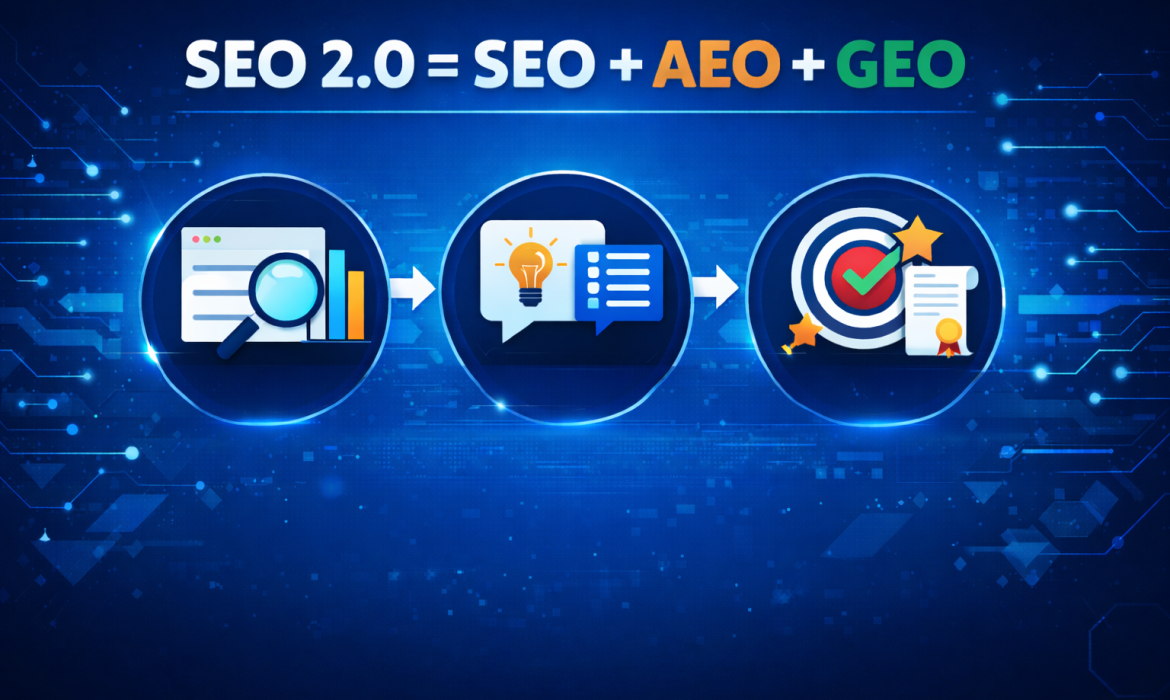
This is where SEO 2.0 comes in: SEO doesn’t disappear, it expands. The extension goes in two directions: AEO (to be the answer) and GEO (to be the recommendation).
Classic SEO remains the foundation (indexing, structure, relevant content, authority). But AI Search compresses options: often users receive only 1–3 recommendations or a direct answer. This creates two new needs:
Extractable content
Clear trust signals
AEO = SEO 2.0 for Answers
AEO (Answer Engine Optimization) means structuring your content as answers to real questions, in a format easy for AI and Google to extract.
How AEO looks in practice:
Answer-first: provide the answer in the first 1–2 sentences under each H2.
Lists, numbered steps, tables, checklists (not just long paragraphs).
FAQ with real questions (8–12 on important pages)
Schema markup (FAQPage / Article) where it makes sense.
GEO = SEO 2.0 for Recommendations
GEO (Generative Engine Optimization) means building signals that increase the chance a generative AI model will recommend you: clear entity, evidence (E-E-A-T), consistency, and external footprint (mentions/citations).
How GEO looks in practice:
Clear entity: who you are, what you offer, for whom, location (Romania/cities).
Evidence: real author, team, results, testimonials, case studies.
External footprint: mentions in relevant sources (lists, articles, PDFs), no spam.
Consistency: same description everywhere (site, LinkedIn, directories).
SEO 2.0 (AEO + GEO): “I want a quality sofa bed, delivered in 2 days, in Bucharest” → page that clearly answers (answer-first), short list (2–3 options), FAQ (delivery/returns/warranty), evidence (reviews, materials) + external footprint (citable assets).
External Links (Useful Sources)
Google Search Central: official documentation
Schema.org FAQPage: FAQPage specification
Ahrefs (LLM citations): guide on LLM citations
FAQ (for Page / Article)
Do AEO and GEO replace SEO? No. AEO and GEO complement SEO. SEO remains the foundation, while AEO/GEO are extensions for answers and recommendations in AI Search.
How many prompts should I monitor? A good set is 20–60 prompts, divided by intent (informational, commercial, comparative).
Does FAQPage schema help? Yes, it helps maintain consistent Q&A structure, but the most important thing remains clear content and real questions.
How long until results appear? Generally, initial signals appear in 30–90 days, depending on niche, authority, and external footprint.
What is more important: mention or citation? Mentions increase awareness. Citations bring authority and clicks when available. The most valuable are the top 1–3 recommendations for commercial prompts.