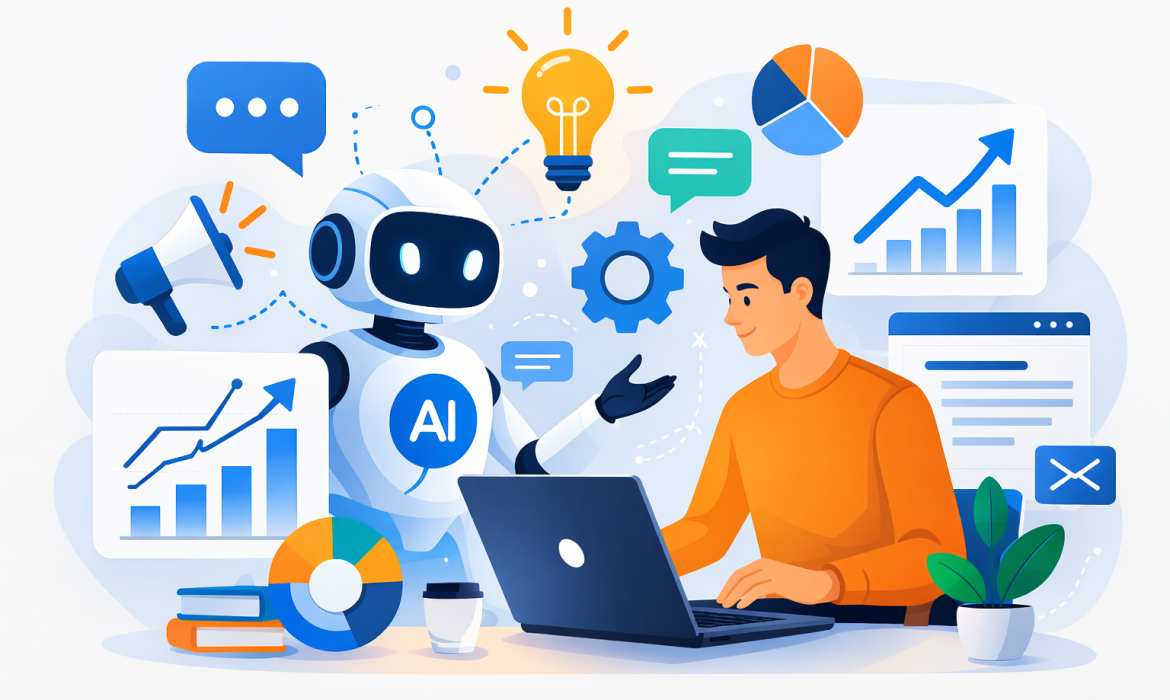
AI marketing is most effective when it accelerates research, production, analysis, and iteration without replacing strategy, creativity, or quality control. Practical examples analyzed by Ahrefs show that AI delivers real results when used to support marketers, not replace them.
For companies in Romania, the takeaway is clear: it’s not about using numerous tools at random, but about having a few well-defined processes where AI optimizes efficiency. For visibility in both Google and AI-generated responses, we recommend integrating these processes with SEO for ChatGPT, AEO, and GEO.
Table of Contents
ToggleWhy AI Marketing Matters in 2026
AI marketing is valuable because it reduces time spent on repetitive tasks such as summarizing, structuring, generating ideas, message variants, review analysis, grouping themes, and turning raw notes into clear deliverables. This allows teams to test more in less time.
However, speed alone is not enough. Using AI without a clear process leads to generic content and campaigns similar to others. A well-structured workflow provides a real operational advantage.
In short, AI marketing does not mean automatic results. It means using AI to accelerate essential activities: research, positioning, clarity, and execution.
8 AI Marketing Examples That Actually Work
Analyzing reviews to uncover what matters to customers
One of the most useful examples is analyzing customer or competitor reviews. AI can quickly spot patterns: what customers appreciate, what frustrates them, recurring phrases, and which benefits influence purchasing decisions.
This information can then improve messaging in ads, product pages, landing pages, or emails. For local businesses or online stores, this is an easy-to-implement tactic.
Generating visual concepts before the final product exists
AI is useful for creating mockups, visual directions, or concept images in the pre-launch phase of a campaign. You can quickly test creative angles, scenes, and messaging before investing in full production.
This approach is valuable for teams with tight deadlines. It’s essential that AI-generated images reflect the real product, as discrepancies can affect conversion and customer trust.
Combining real photography with AI-generated backgrounds
A practical application is using AI to create backgrounds, scenes, or settings while photographing the real product professionally. This reduces production costs without compromising the presentation of the main product.
This method works well for products, accessories, cosmetics, packaging, or other items that need a premium look without complex interactions with the environment.
Accelerated research for articles and reports
AI can significantly cut research time. It can summarize interviews, survey responses, internal notes, technical documents, or long articles, helping teams quickly identify key ideas.
This process doesn’t eliminate the need for verification but greatly reduces time spent reading and reorganizing information. For educational or commercial content, this is one of the most valuable uses.
Turning raw notes into newsletters or clearer materials
Many teams use AI to transform bullet points, disorganized ideas, or voice notes into a coherent draft. A specialist then edits, adjusts, and adds practical experience.
This method works well for newsletters, short articles, weekly updates, educational emails, and client summaries.
Faster brainstorming for videos, campaigns, and posts
AI can quickly generate multiple angles, titles, hooks, thumbnail ideas, and content structures. Not all will fit, but it provides an efficient starting point.
For content and social media teams, AI facilitates idea exploration. Final decisions remain with the team, but idea generation becomes faster and more efficient.
Automating repetitive production tasks
AI can automate tasks like rewriting meta descriptions, generating alt text for images, formatting text, structuring drafts, or breaking long content into shorter versions.
The benefit is not only time-saving but also increased consistency. For high-volume workloads, AI helps maintain a high standard of delivery.
Optimizing content for classic and AI search
A relevant SEO AI example is using AI to identify missing topics, real frequently asked questions, and generate clearer answers. Instead of writing just for keywords, you can structure content to be easily extracted and cited.
For a deeper dive, see our guides on SEO for ChatGPT, the difference between SEO and AEO, and how to write answer-first paragraphs.
Lessons You Can Apply to Your Website
The most important lesson is that AI delivers the best results in a well-structured process. It cannot replace strategy, differentiation, or audience understanding.
- Use AI for research and organization, not just text generation.
- Test multiple message, title, and creative angle variants.
- Keep human control over examples, data, tone, and conclusions.
- Turn customer feedback into better content.
- Build content that clearly answers real questions.
If you already have a blog, start by optimizing existing articles: rewrite introductions, clarify subtitles, add direct answers, FAQ sections, and internal links to service pages. For inspiration, see our article on SEO for ChatGPT.
Connecting AI Marketing to SEO, AEO, and GEO
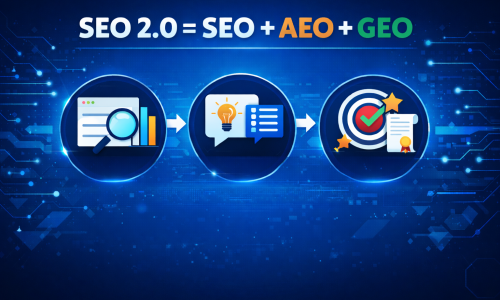
AI marketing and AI Search are different but complementary concepts. AI marketing streamlines content creation, while SEO, AEO, and GEO structure it for easy understanding, extraction, and recommendation.
For example, a good AI Search article should include:
- Clear answers in the first sentences of each section
- Titles that reflect real questions
- Easily extractable lists and steps
- Clear authorship and trustworthy pages
- Interlinking to important site pages
For a Romania-focused strategy, see our guide on SEO for ChatGPT Romania, our practical GEO page, and our article on LLM citations, traffic, and brand authority.
Frequently Asked Questions
What does AI marketing mean?
AI marketing means using artificial intelligence for research, analysis, content ideas, assisted production, testing, and optimization. AI doesn’t replace strategy; it accelerates execution and helps teams make better decisions.
Can AI completely replace a marketer?
No. AI can automate repetitive tasks and generate quick variants, but strategy, positioning, information validation, creativity, and final decisions remain human responsibilities.
What are the best uses of AI in marketing?
The best uses include accelerated research, data summarization, generating creative variants, structuring content, analyzing customer feedback, campaign ideas, and workflow optimization.
How do you connect AI marketing with SEO, AEO, and GEO?
AI marketing helps teams create clearer, better-structured, and more extractable content for AI engines. Combining AI marketing with SEO for ChatGPT, AEO, and GEO is more effective than using AI for quick text alone.
Is publishing AI-generated text enough?
No. Texts without human editing risk being generic, incomplete, or inaccurate. Good content uses AI for speed but maintains human control for experience, examples, validation, and differentiation.