
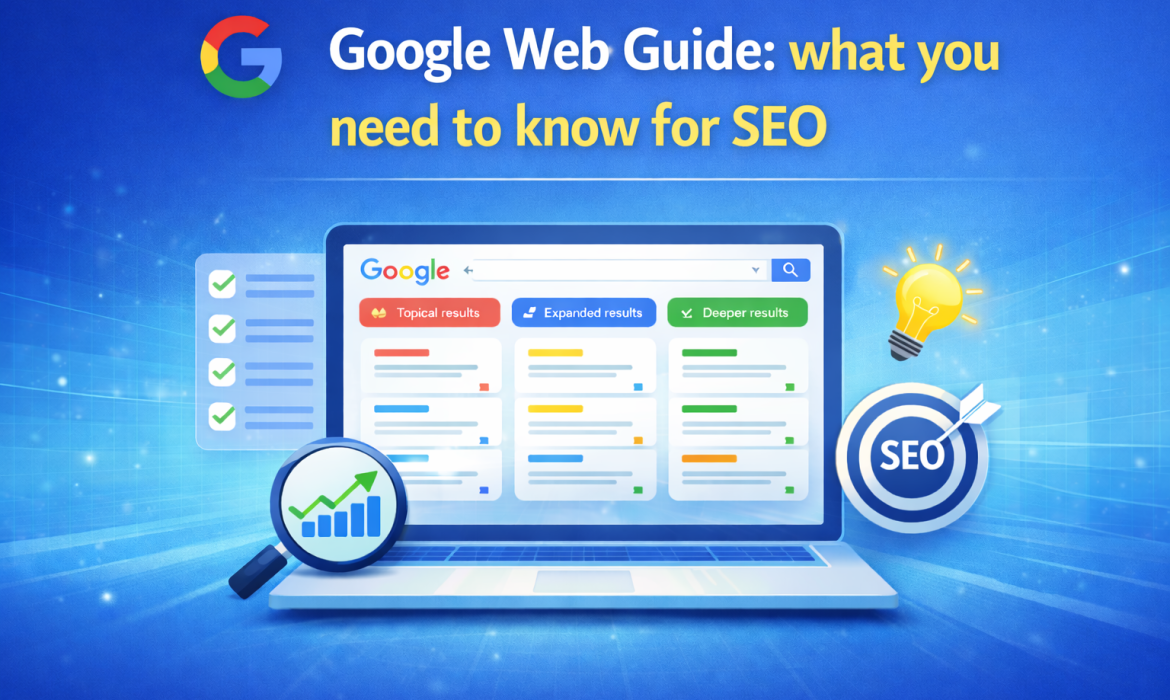
Google is changing the way search results are presented again. After AI Overviews and AI Mode, there is now Google Web Guide, an AI-driven search experience that groups results by topic, angle, and intent instead of relying only on a flat ranked list.
In simple terms, Google Web Guide does not treat search as just a list of ten links. It tries to understand what the user is really exploring, which related subtopics matter, and which pages deserve visibility for each angle of that intent.
For SEO, that matters because it is no longer enough to have one indexed page with the exact keyword in the title. You need content that is easy to understand, easy to extract, easy to cluster, and strong enough to answer several related questions around the same topic.
If you want to see why classic SEO is moving closer to AEO, GEO, and SEO for ChatGPT, Web Guide is one of the clearest examples.
How to optimize content for Google Web Guide
There is currently no separate public rulebook created only for Web Guide. But there is a very clear direction: strong SEO fundamentals plus very clear intent-driven content. Google Search Central also says that the best SEO practices remain relevant for AI features in Google Search and that there are no extra requirements or special optimizations needed just to appear in AI features.
1. Write answer-first
At the beginning of each H2 or H3 section, answer the question directly in the first one or two sentences. Then expand. This helps both readers and extraction systems.
2. Cover real sub-questions
If Google expands a query through fan-out, your page should be built with the same mindset. Do not only write about the main topic. Also cover the questions people naturally ask around it.
For example, on a page about SEO for ChatGPT, related sub-questions might include:
- what SEO for ChatGPT actually means,
- how AI mentions a brand,
- the difference between a mention and a citation,
- why author pages matter,
- how to measure visibility in AI Search.
3. Use extractable structure
Lists, tables, checklists, short definitions, comparisons, and numbered steps are easier to interpret and repurpose. Not because content should sound robotic, but because clear pages are easier for modern search systems to work with.
4. Build logical internal linking
Internal linking becomes even more important when search systems are mapping relationships between topics. If you have one main page and several supporting pages that explain related angles, Google can understand the structure more easily.
For a brand that wants visibility in AI-driven search, blog articles should support service pages such as:
5. Make the entity clearer
Web Guide, like AI Search more broadly, favors sources that are easy to understand. That means clear About, Team, author, and contact pages, a consistent brand description, and visible signs of real expertise.
6. Keep content accessible and readable
Google still recommends the basics: crawlability, indexability, accessible text content, good page experience, appropriate structured data where relevant, and helpful people-first content. Google has also said that AI-generated content itself is not against its guidance if it is created to help users rather than manipulate rankings at scale.
What to avoid
If Web Guide is based on understanding, grouping, and fast selection, weak content has even less room to compete. Avoid:
- artificially inflated pages with no clear answer,
- long introductions that say nothing specific,
- articles written only around a keyword target,
- repetitive content spread across multiple pages,
- service pages that stay too vague,
- missing authors or trust signals,
- generic FAQs that do not match real user intent.
A better way to think about content in 2026
Web Guide shows something important: the future of search is not only about winning clicks from a flat ranking page. It is about being selected across multiple contexts. That requires a shift in strategy.
It is not enough to be indexed. You need to be easy to understand, easy to extract, and easy to connect to user intent.
For many brands, that means moving from the mindset of “publish one article for one keyword” to a more mature model:
- one clearly defined main topic,
- supporting pages that cover secondary angles,
- short and direct answers,
- real examples and comparisons,
- consistent internal linking,
- measurement across AI environments, not just the classic SERP.
Frequently asked questions about Google Web Guide
What is Google Web Guide?
Google Web Guide is a Search Labs experiment that groups results into themed sections using AI, helping users explore different angles of a topic more easily.
How does query fan-out work?
Query fan-out expands an original search into multiple related searches, then combines and groups the most relevant results. This allows Google to show several perspectives for the same question.
Is Web Guide good for websites?
It can be. Because Web Guide organizes search by topic angles, it may create new visibility opportunities for highly useful pages that solve one specific aspect of user intent well.
Do I need a separate SEO strategy for Web Guide?
Not a completely separate one. The emphasis simply moves even further toward helpful content, clear structure, real expertise, topical coverage, and logical internal linking.
How is Web Guide related to SEO for ChatGPT?
Both reward content that is easy to understand, easy to extract, and strong across multiple intent angles. Web Guide reinforces the same direction we already see across AI-assisted search and answer engines.
External sources
- Google – Web Guide: An experimental AI-organized search results page
- Google – Supporting the web with new features and partnerships
- Google Search Central – AI Features and Your Website
- Google Search Central – Google Search’s guidance about AI-generated content
- Ahrefs – Google Web Guide: What It Is, How It Works, and What It Means for SEO

